
 By admin
Dear Biafranwarreports readers, how are you today ? we do wish you are all well in these global trying times and hope you all hang in there, wherever you are.
Today, we bring you a new topic amongst many more to come, we have so many real reports for our audience, that what we’ve reported so far, is just the tip of the iceberg.
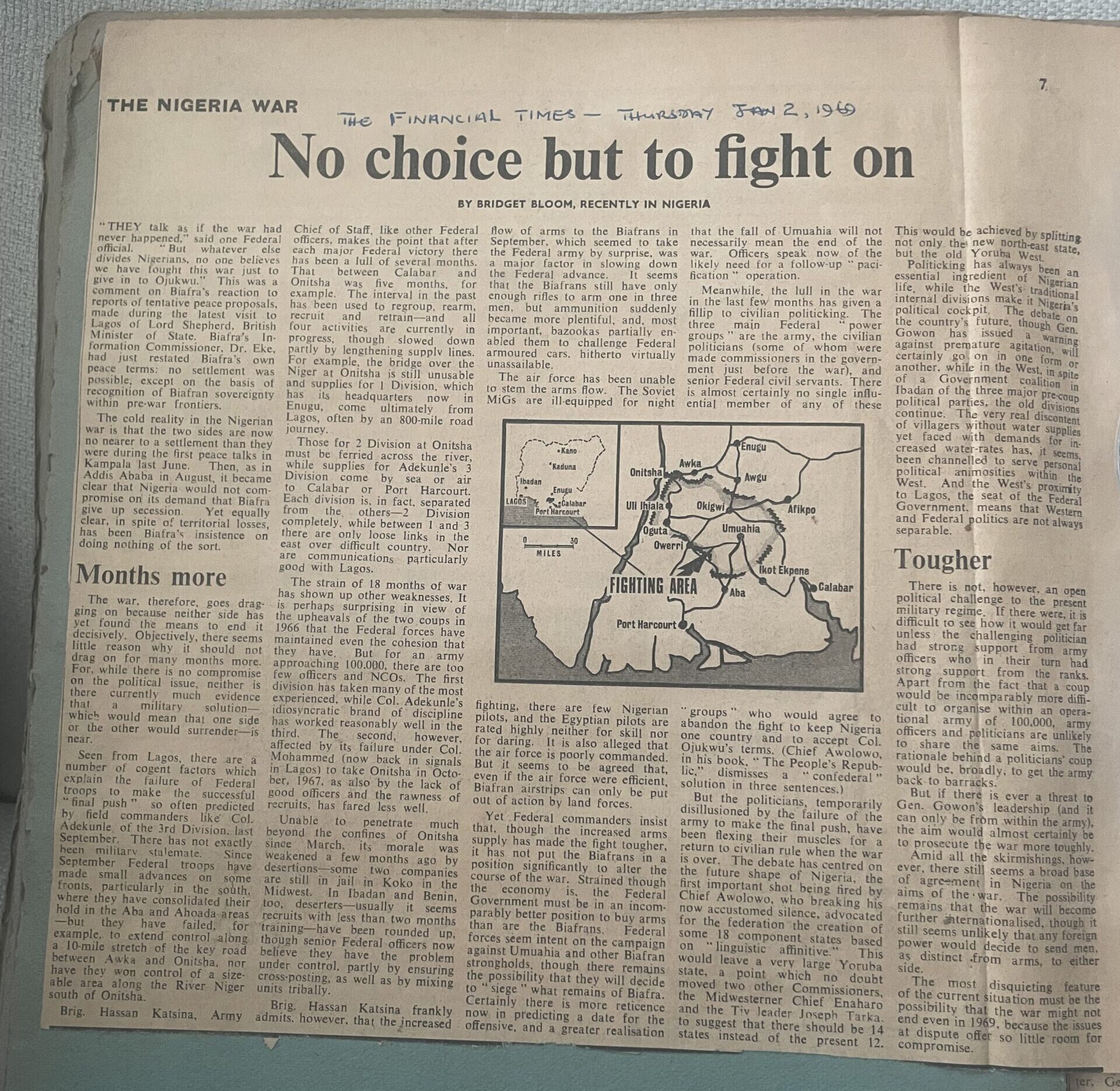
This Topic is a report by the London Financial time by Bridget Bloom, with a slightly confusing headline, as seen above.
Naturally, the zeal to ‘fight on’, is normally attributed to the Biafrans, who were always at a militarily – lack of decisive weapons; politically – lack of international allies and recognition; financially – no real tradable capital or goods under a severe blockade; agriculturally – not enough food to feed its army and populace.
But No ! the quote/headline above, came from a Nigerian official in response to a Biafran proposal for peace, during the visit of the Lord Shephard, the British minister of state, by Dr Eke, the Biafran information commissioner.
The article by the London Financial Times, dated January 2 1969, goes on to touch on various aspects of the war mainly from the Nigerian side.
A summary of this good article is that it touched on many crucial aspects of the war, starting with the fact that since the first peace conference in Kampala, Uganda the previous year, no side seems to have politically come up with any proposal to end the war; Biafra insist on sovereignty, whilst Nigeria insist on its 12 state structure.
The article furthers by saying militarily, both sides again were in some stalemate as the Nigerians, though stronger in all military and territorial aspects, can’t seem to deliver the final blow and Biafra though diminished and under-armed, seems determined to carry on.
The article predicted that the war would probably go on for months more due the above reasons and it also touched on the issues and excuses of the Nigerian field commanders for their inability to finish of the Biafrans – issues to do with logistics and supply, re-training and re-fitting, re-arming and recruiting etc and also the paucity of trained officers for such a large army of about 100,000 soldiers, there were also issues with communication between the divisions and between the division and Lagos army headquarters.
The Nigerian army chief, Brig Hassan Katsina, admitted that the sudden increase in arms supply to Biafra, was another reason as to why Nigeria was struggling to fulfil its so called final pushes. The Nigerian Airforce wasn’t painted in a good light either as the article described them as poorly led and ill equipped to fight at night in order to cut the Biafran night supplies, and that the pilots both local and foreign were grossly inept.
The article the goes on to discuss the internal affairs and politics of wartime Nigeria, including the views of Chief Obafemi Awolowo – The second in command of the Nigerian government – who reiterated his desire to see Nigeria further divided into more states, 18 to be precise. This stance of his prompted other political heavyweights in government, like Joseph Tarka; the leader of the Tivs in the middle belt to also clamour for state creation according to the article.
The article concludes by delving into intra-Yoruba politics and possibilities of Gen Gowon hanging onto power during and post war Nigeria.
I’ll let the reader enjoy the article itself, as is our tradition here at Biafran-war-reports. Please continue to visit and share our links freely, we truly appreciate you, our reader.
Click to enlarge and read, thanks.